New research shows AI agents break their instructions far more often after a long job gets summarized to save space, even when the rule is still sitting right there in the summary. Here is what that means for a small business handing real work to an agent, and the simple shift-change habit that keeps your rules in charge.
By Warren Schuitema, AI Systems Consultant, Matchless Marketing / Matchless AI
Published: November 11, 2026 | Last Updated: November 2026

You tell your AI agent one rule at the start. "Never offer a refund without asking me first."
It follows that rule on the first email. And the tenth. And the fortieth.
Then, somewhere deep into a long afternoon of work, it offers a customer a refund. No question. No check. Your rule was right there. It just stopped acting on it.
If that has happened to you, you're not imagining it. A research team at Vrije Universiteit Amsterdam just put numbers on it.
So why does your AI agent forget your rules halfway through a long job? Here's the short answer. When a job runs long, many agent tools squeeze the earlier conversation into a summary to make room for new work. After that squeeze, agents in this study broke a stated rule far more often. And here's the surprising part. Most of the time, the rule was still in the summary. The agent could see it and broke it anyway.
The fix is a better shift structure. Short jobs. Rules re-loaded at the start of every job. A written handoff between jobs. And your yes on anything that matters.
Key Takeaways
- A November 2026 study from Vrije Universiteit Amsterdam found the share of test tasks where an AI agent broke a stated rule rose from 9.6% to 37.8% after the agent's history was compacted.
- In most compacted runs, 70.1%, the rule was still fully there. Those runs still broke the rule 2.6 times as often as runs with the full history.
- Earlier research points the same way: AI models get less reliable as their input grows, and they use information buried in the middle of a long input worst.
- Only 16% of small business owners have deployed an AI agent, per a 2026 Bluehost study, so most owners are setting their habits right now.
- My fix: treat every long AI job like a factory shift. Short shifts, rules posted at the station, a written handoff, and a fresh start.
New Research Shows Agents Break Rules They Can Still See
The study. On November 2, 2026, researchers at Vrije Universiteit Amsterdam posted a paper called "Do Agents Still Follow the Rules? Benchmarking Rule Compliance under Agent Context Compaction." They built a test called ARCBench. It's a preprint, so it hasn't been peer reviewed yet.
What "compaction" means. Every AI model has a limit on how much it can hold in view at once. When an agent works on a long job, the conversation keeps growing. Eventually it runs out of room. Many agent tools handle that by writing a summary of the earlier history and replacing the full history with the summary. That's compaction. Think of it as the agent writing itself a cheat sheet and throwing away its notes.
What they tested. The main experiment used 17 task cases across 4 AI models. Each task gave the agent a rule and a job to do. Then they compared two versions. One where the agent kept its full history. One where the history got compacted partway through.
What they found. With the full history, the agent broke the rule in 9.6% of the task cases. After compaction, that number jumped to 37.8%. That's close to four times higher.
The part that got my attention came next. You'd guess the summary just dropped the rule. Mostly, it didn't. In 70.1% of compacted runs, the rule was fully retained. Another 26.9% kept it partly. Only 3.0% lost it entirely.
And the runs that kept the rule? They still broke it 2.6 times as often as runs with the full history. The researchers put it this way: "compaction rarely deletes the rule."
So the rule survives. What fades is the agent's grip on it. The rule is on the page, and the agent stops treating it as a rule.
The authors also found that text planted to target the summary step "more than doubles violations." So be careful what outside content a long-running agent reads.
Long Jobs Are Where Small Business Owners Get Burned
Here's why this matters to someone running a business from a spare bedroom.
The whole point of an AI agent is to hand it the long, boring jobs. Work through 200 customer emails. Clean up a year of receipts. Update every product description in the store. Draft a month of social posts. Those are exactly the jobs that run long enough to trigger compaction.
And those jobs usually come with rules. Real ones.
- Don't promise a ship date.
- Never offer a discount over 15%.
- Don't email anyone on the do-not-contact list.
- Ask me before you change a price.
When you run the business alone, you can't watch every step. So a rule that quietly stops working on step 140 is a rule you won't catch until a customer catches it for you.
I spent 16 years in manufacturing and supply chain before I built my first AI system. One thing that world teaches you early: quality problems rarely show up at the start of a shift. People are fresh. The setup is clean. The work instructions are right in front of them. Problems creep in late. Long runs. Tired crews. A handoff where somebody summarized the instructions out loud instead of handing over the sheet.
That's what this study looks like to me. A long shift, a sloppy handoff, and a rule that got heard but not followed.
The Evidence Has Been Piling Up for Three Years
This new paper fits a pattern researchers have been reporting since 2023.
Models use the middle of a long input worst. In 2023, a team led by Nelson F. Liu published "Lost in the Middle: How Language Models Use Long Contexts." They found that performance "is often highest when relevant information occurs at the beginning or end of the input context." When the important information sat in the middle of a long input, performance dropped. Even for models built for long inputs. Your rule at the top of a long conversation slowly drifts toward the middle as the job grows.
More input, less reliability. In July 2025, the AI company Chroma published a report called "Context Rot." It tested 18 AI models, including GPT-4.1, Claude 4, Gemini 2.5, and Qwen3. The finding, in their words: "model performance consistently degrades with increasing input length." Longer jobs mean longer inputs. Longer inputs mean shakier results.
Rules survive the summary but lose their grip. ARCBench adds the newest piece: the 2.6 times jump in broken rules, even when the rule made it through.
Now look at where small businesses are right now.
Most owners are just starting with agents. A Bluehost study of 350 U.S. small business owners, run in May 2026, found that 79% are aware of AI agents. Only 16% have actually deployed one. Bluehost sells AI tools, so read that with a grain of salt, but the gap is the story. Most owners haven't set their agent habits yet.
And they feel the pressure to start. A 2025 report from Reimagine Main Street, a project of the Public Private Strategies Institute in partnership with PayPal, surveyed nearly 1,000 small business owners. 82% said adopting AI is essential for staying competitive.
Owners feel they have to use agents. Most are just starting. And agents get less reliable the longer a single job runs. The habits you set this winter decide whether your agent keeps your rules in the spring.
Treat Every Long AI Job Like a Factory Shift
Here's my take, and it comes straight from the plant floor.
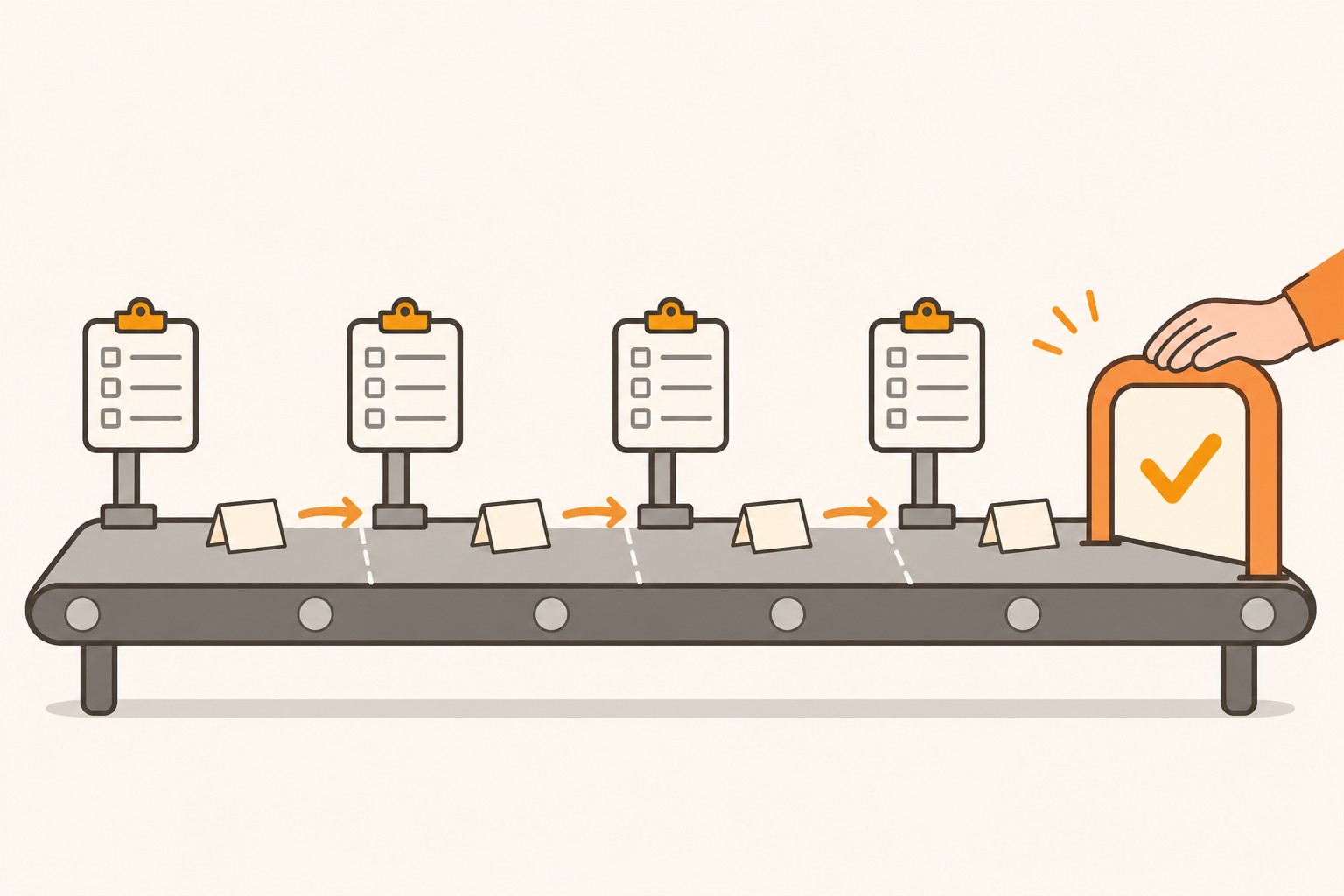
A factory doesn't run one endless shift and hope the night crew remembers what the morning crew was told. It runs shifts. Each shift starts at the station with the work instructions posted. Each shift ends with a written handoff. The next crew reads the sheet itself.
I call this the Shift Change Rule for AI agents. Four parts.
1. Short shifts. Break long jobs into chunks small enough to finish before the agent's history gets squeezed. Fifty emails at a time. One product category at a time.
2. Rules posted at the station. Your rules live in a short written file you can see and edit. Every new chunk of work starts by loading that file fresh, right at the top. That's where the research says models pay the most attention.
3. A written handoff. At the end of each chunk, the agent writes a short recap. What's done, what's open, what it noticed. The next chunk starts from your rule file plus that recap, a clean page you can read yourself.
4. Your yes at the gate. Anything that sends, posts, spends, or promises still comes back to you. If a rule slips, it slips into a draft you haven't approved yet. That's a cheap mistake instead of an expensive one.
Notice what's missing from that list: hoping the agent remembers better. A better shift structure works with the agent you already have, and you can set it up this week.
My AI Workforce Starts Every Shift From the Rulebook
Matchless Marketing runs day to day on a workforce of AI agents. Each one has a name, a written job description, and one lane. One drafts content. One keeps the numbers. One handles admin. This article started in that system.
Here's how every work session starts, every single time. Before an agent does any work, it reads the shared memory file. Then the decisions log, newest first. Then its own state file and its last recap. Then its job description. Only then does it start the work.
One session runs one role. The content agent doesn't wander into bookkeeping halfway through the afternoon.
And every session ends the same way. The agent updates its state file and writes a recap of ten lines or less. The next session picks up from that recap and the rulebook.
The biggest rule is written into every agent's instructions. Nothing sends, posts, invoices, books, buys, or spends without my word. The agents draft. I approve. I'm the only gate.
When I read the ARCBench paper, I saw why that structure earns its keep. Short sessions keep each job small. Loading the rules first puts them at the top, where models use them best. The written recap replaces the kind of machine summary the study tested. And the approval gate catches whatever still slips through.
It's the same thinking that runs my house. When I built our Weekly Meal Planner, it replaced HelloFresh and ended our Sunday planning spiral. I decided the rules once: what we eat, what the kids will actually eat, and what fits the grocery budget. The planner does the repeat work inside those rules every week. I don't re-argue them every Sunday.
Rules decided once. Loaded every time. That's the pattern.
What Does This Look Like in a Real Small Business Job?
Here's a quick example to make it concrete. This is a made-up shop, not a client story.
Picture a mom who runs an online candle shop from her kitchen. It's mid-November, and her inbox has 300 unanswered customer emails. She asks an AI agent to draft replies to all of them in one long session. She gives it three rules at the start. Never offer a refund over $25 without asking. Never promise delivery by a specific date. Flag any angry email for her to handle personally.
The first hundred drafts look great. Somewhere past that point, the session gets long and the tool compacts it. By the end, a few drafts promise "arrives before Christmas." One offers a $40 refund. Her rules are still in the summary. The agent just stopped acting on them.
Now run the same job with the Shift Change Rule. She writes her three rules into a short file. She runs the emails in batches of 50. Each batch starts by loading the rule file fresh. Each batch ends with a short recap: how many drafted, how many flagged, any refund requests. Every draft waits for her yes before it sends.
Same agent. Same emails. Six short shifts instead of one long one. And when something does slip, it slips into a draft she reads before a customer ever sees it.
7 Steps to Keep an AI Agent on Your Rules
- Write your rules in one short file. Open a plain document and list the rules your agent must never break. Keep it to one page, in plain words: "Never offer a refund over $25 without asking me." Save it where you can paste or attach it in seconds.
- Put the rules first, every time. Start every new session or batch by pasting or attaching that rule file before you give the task. Research on long inputs shows models use the beginning best. Don't rely on a rule you typed three hours ago.
- Cut long jobs into batches. Break any big job into chunks you could check in ten minutes. Fifty emails. Twenty product listings. One week of receipts. Start a fresh session for each batch instead of one marathon.
- Ask for a written recap at the end of each batch. Tell the agent: "Before you stop, write five lines on what you finished, what's left, and anything that broke a rule." Use that recap plus your rule file to start the next batch.
- Watch for the warning signs. If your tool says it's summarizing or compacting the conversation, treat that as a shift change. Stop, start a fresh session, and reload your rules. Same if the agent starts repeating itself or forgetting details from earlier.
- Keep your yes on anything that leaves the building. Emails, posts, refunds, price changes, payments. Have the agent draft them and hold them for you. A broken rule in a draft costs you thirty seconds.
- Spot-check the late work hardest. When you review, check the last batch more closely than the first. That's where the research says rules slip. If you find a slip, tighten the batch size next time.
Frequently Asked Questions
Why does my AI agent stop following my instructions in long conversations?
As a long job grows, many AI tools summarize earlier history to make room, which is called compaction. A November 2026 study found agents broke stated rules far more often after compaction, even when the rule survived in the summary. Models also use information in the middle of long inputs less reliably than the beginning.
What is context compaction in AI?
Context compaction is when an AI tool replaces a long conversation history with a shorter summary so the agent can keep working. Every model can only hold so much at once. Compaction frees up room, but details and rules from earlier can lose their weight once they're squeezed into a summary.
Will a newer, smarter AI model fix this?
Don't count on it. Research from 2023 through 2026 has found long inputs causing trouble across many models, including well-known ones. Better models may help, but the reliable fix is structure: short jobs, rules loaded at the start of every session, written handoffs, and your approval before anything sends or spends.
Is it safe to let an AI agent handle customer emails?
It can be, with guardrails. Keep your rules in a short written file, run emails in small batches, and have the agent draft replies instead of sending them. Review every draft before it goes out, and look hardest at the later batches, where research suggests rules are most likely to slip.
What is the easiest first step for a beginner?
Write your top three rules on one page in plain words. Then start every AI session by pasting those rules in before you give the task. Keep each job small enough to check in ten minutes. That one habit puts your rules where models pay the most attention.
Short Shifts, Fresh Starts, and Your Yes
Remember that refund rule? "Never offer a refund without asking me first."
Your rule was fine. The shift was too long, and a summary was left to carry your rules all the way to the end.
Nobody runs a plant that way. You don't have to run your AI that way either.
Give the agent short shifts. Post your rules at the station. Ask for a written handoff. Keep your yes on anything that reaches a customer or touches your money. That's the whole system, and you can set it up before dinner.
So run the test I run on every system in my business and my home. Does it give me back Time, Money, or Energy?
Time, because you stop re-checking a whole day of work and only check short batches. Money, because a slipped rule turns into a draft you catch before it becomes a refund you pay. Energy, because you can hand over the long jobs and stop wondering what the agent did at step 140.
Your rules are only as strong as the last time the agent read them. Make that every time. That's A Better Way.
Keep Learning
- Should You Let an AI Agent Run Your Small Business Holiday Marketing Campaign? The three approval gates to set before an agent touches your store, your list, or your ad budget.
- How Do You Get ChatGPT and Claude to Remember the Same Things About Your Business? Keep your brand rules in one file every AI tool can use.
- Should You Let AI Read Your Bank Account? Why AI should look and explain before it ever acts.
- Should Your Small Business Use the Free AI Tools Your Bank Is Offering? What to check before you hand business data to a new AI tool.
About the Author
Warren Schuitema is an AI Systems Consultant with Matchless Marketing and Matchless AI. He spent 16 years in manufacturing and supply chain, where every shift starts with the work instructions posted at the station, before he started building AI systems for small businesses and families. His business runs day to day on a workforce of AI agents that start every session by reading their rulebook and end it with a written recap, with one firm rule: nothing posts, sends, or spends without his yes. At home, his Digital Wall Calendar replaced a $50 a month subscription and his Weekly Meal Planner replaced HelloFresh. He helps small business owners and parent entrepreneurs build practical AI systems that give back Time, Money, or Energy, and he is a partner in the Goal Achievers Summit.