AI made scam messages cheaper, faster, and far more convincing this year. Here is the simple process fix that stops most of them, no tech degree required.
By Warren Schuitema, AI Systems Consultant, Matchless Marketing / Matchless AI
Published: October 15, 2026 | Last Updated: October 2026

Two security stories landed on the same day this week, and I read them back to back at my kitchen table.
On October 14, Microsoft announced it had helped take down a network of phishing kits that sent more than 1 billion scam emails and text messages since January. The same day, the security firm Semperis released a ransomware survey where 84 percent of respondents said attackers used AI in the attacks.
One billion messages. That is a factory, and it runs every day.
So how do you protect your small business from AI-powered scams in 2026? Here is my answer. Stop trying to spot the fake. Build your business so that no single message can move money, change a password, or share a file without a second check through a channel you already trust. Add the basics on top of that: multi-factor login, backups, and a little training for your family and your team.
AI made the scams better. It did nothing to the rule that you never pay on one message alone. That rule still wins.
I run my business with a workforce of AI agents. They write, research, schedule, and draft all day. And they all live by one rule I wrote: nothing sends, pays, books, or signs without my word. I built that rule to keep my business on track. It turns out to be one of the best scam defenses I have.
Key Takeaways
- Scammers now use AI to write cleaner emails, fake familiar voices, and send messages at a scale no human crew could match.
- Small businesses take a big share of the hits: in one national survey, 72 percent of small business owners said they were hit by fraud, scams, or ransomware in the past year.
- Spotting fakes by eye gets harder every month, so the strongest defense is a process: no money moves on one message.
- Verify every request for money, passwords, or bank changes on a second channel you already trust, like a phone number you saved yourself.
- Multi-factor login and tested backups are cheap, boring, and still among the most useful things you can set up this week.
Today's Scam Looks Like Your Best Customer
Remember when scam emails were easy to catch?
Bad spelling. Weird greetings. A prince who needed your help.
That era is over. Today the email sounds like your vendor. It uses your real invoice number. It arrives at 4:45 on a Friday, when you are tired and trying to get to your kid's game. And it asks for one small thing. Update the bank details. Approve this payment. Log in to check the shared file.
If you run a small business from home, you feel this harder than most. You are the CEO, the bookkeeper, the IT department, and the person who answers the phone. Your work email and your family life share one laptop and one brain. Nobody sits down the hall to ask, "Hey, does this look right to you?"
That is the gap scammers aim at. A busy owner, alone, under a little time pressure.
And now they have AI on their side. The same tools you use to write a client email in two minutes, they use to write a thousand fake ones. The same voice tech that powers helpful phone agents can copy a voice from a short clip. I wrote about the good side of that tech in my post on AI phone agents for small business. This is the other side of the same coin.
I do not say this to scare you. I say it because the old advice, "look for typos," is quietly failing. If your whole defense is your own eyes, the game gets harder every month.
Here Is What Happened This Week
Two stories hit on Wednesday, October 14.
Microsoft took down a phishing factory. According to CyberScoop, Microsoft worked with Japanese authorities, Health-ISAC, and several security companies to shut down three connected services that sold phishing kits to criminals. Microsoft tracks the group behind them as Storm-2990. Since the start of 2026, those kits were used to send more than 1 billion phishing emails and text messages, reaching more than 75,000 organizations around the world.
The lures will sound familiar. A package that could not be delivered. An unpaid toll. A bank alert that needs your attention. An overdue tax bill.
Steven Masada, who leads Microsoft's Digital Crimes Unit, put the problem in one line: "Delete and block one, and another takes its place."
You cannot block your way to safety. There will always be another message.
A ransomware survey put AI at the center. The same day, Semperis released its 2026 ransomware report. As reported by Cybersecurity Insiders and WDBO, it surveyed about 1,200 IT and security professionals in nine countries. More than 84 percent said AI was used in the ransomware attacks they dealt with. About 59 percent of those hit said they had paid a ransom at least once, and about 69 percent were hit more than once.
This is a survey run by a security company, and it measures what victims reported, not a count of every attack. Treat the 84 percent as a strong signal from the people on the front line and keep the exact number loose.
Even so, the direction is clear. Criminals are riding the same AI wave we are.
The Numbers Say Small Businesses Are a Main Target
The FBI saw record losses. The FBI's Internet Crime Complaint Center received 1,008,597 complaints in 2025, with reported losses of $20.877 billion. That is a 26 percent jump in losses from 2024. Business email compromise, where a scammer poses as a boss, a vendor, or a client to redirect a payment, caused more than $3 billion in losses from 24,768 complaints. The FBI also logged more than 22,000 complaints that mentioned AI, with losses above $893 million. Businesses reported more than $30 million in losses to email scams that involved AI, and the report notes that voice cloning can be used to request wire payments.
Verizon says small organizations get hit hardest by ransomware. Verizon's 2026 Data Breach Investigations Report found ransomware in 48 percent of all breaches, up from 44 percent the year before. Its summary says small organizations are hit by ransomware out of proportion to their size. A human was part of the story in 62 percent of breaches. And here is a number every parent with a phone should read twice: scam texts and phone calls got clicked at a rate 40 percent higher than scam emails in Verizon's data.
Small business owners say AI is already in the attacks. In April 2026, the Public Private Strategies Institute released a Morning Consult survey of 506 U.S. small business owners. 72 percent said their business was hit by fraud, scams, or ransomware in the past year. Among the victims, 76 percent said AI was used in the attack. Victims of email compromise lost more than $90,000 on average. And only 48 percent of owners said they use multi-factor authentication.
Read that last one again. Fewer than half are using the one tool almost every security expert puts at the top of the list.
Our own AI habits open doors too. Verizon also found that 45 percent of employees now use AI regularly on their work devices, up from 15 percent the year before. And 67 percent of users reach AI tools through personal accounts on those work devices. If your team pastes client info into a personal chatbot account, that data now lives somewhere you do not control.
Put it together. More messages. Better fakes. Text and phone scams that work better than email. And a lot of small businesses running without the basic locks on the door.
AI Scams Attack the Shortcut in Your Process
Here is the reframe I want you to take with you.
Most scam advice is about detection. Check the sender address. Hover over the link. Listen for something off in the voice. That advice is fine. It is also a losing race, because AI keeps making the fake look and sound more like the real thing.
I spent 16 years in manufacturing and supply chain. One lesson you learn fast on a production floor: you cannot inspect quality in at the end of the line. If your plan depends on one inspector catching every bad part, some bad parts will ship. The fix is to design the process so a bad part cannot move forward without a check.
Scams work the same way. Every scam, AI-powered or not, needs one thing from you. It needs you to skip a step. Pay before you confirm. Log in before you check. Act now, before you think.
The urgency is the tell. "Wire this today." "Your account will be locked in one hour." "Mom, I need help right now." The message is built to push you past your own process.
So the real question for a small business owner is simple. Where in my business can one message, from one person, move money or open a door with no second check?
Find those spots and put a gate on each one. Then it matters a lot less how good the fake is.
I call the core of this the Two-Channel Rule. Any request to move money, change payment details, share a password, or grant access gets confirmed on a second channel that you already trust. Not the phone number in the email. Not a reply to the text. A number you saved yourself, a face-to-face check, or a callback to the contact you have used for years.
A scammer can fake one channel very well now. Faking two channels at the same moment is much harder.
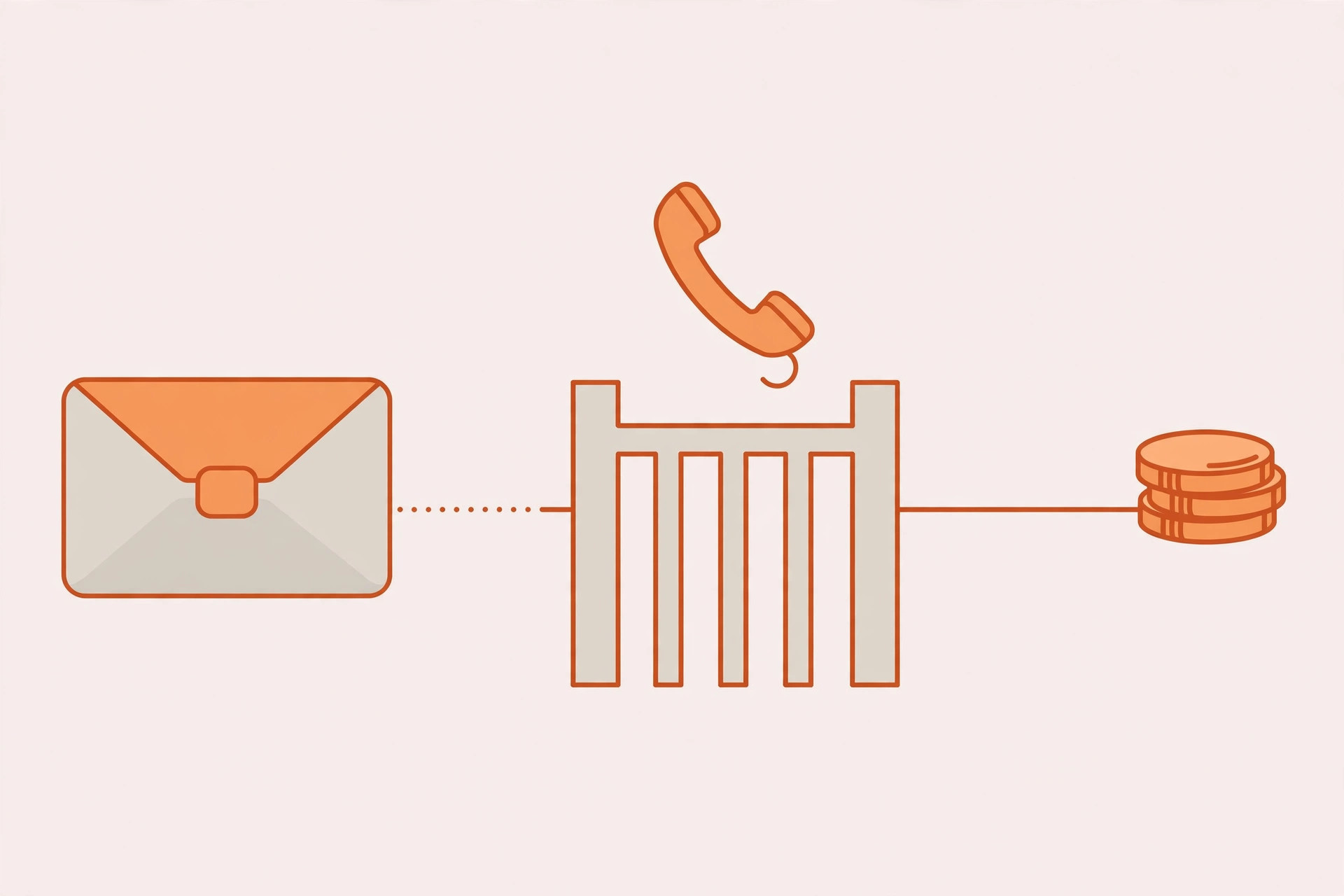
My AI Workforce Runs on an Approval Gate, and That Gate Stops Scammers Too
My business runs on a team of AI agents. Each one has a written job description. One drafts content. One helps with admin. One keeps track of numbers. This article came out of one of those workflows.
When I set them up, I wrote one rule above all the others. I am the only approval gate. Nothing sends, posts, invoices, books, buys, signs, or spends on my behalf. The agents draft. They hold. They wait for my word.
I built that rule for quality. I did not want an AI sending a half-baked email to a client. But look at what the rule does in a world full of AI scams.
If a fake vendor email lands and an agent reads it, the worst it can do is draft a reply and wait. It cannot pay. It cannot change a bank account. It cannot hand over a login. Every one of those actions has to pass through me, and I check money requests on a second channel.
The same rule protects my business from scammers, from bad AI output, and from my own tired Friday afternoons. One gate covers all three.
If you use AI in your business, and you should, give every AI tool the same rule. Draft first. Human approves. Especially for anything touching money, logins, or customer data. Verizon's numbers on personal AI accounts tell you why.
Here is a quick example. This is a made-up business, not a client story.
Picture a small bookkeeping office of three people. A voice message arrives that sounds just like the owner. "I am stuck at the airport. Please pay the new vendor today. I texted you the account." Without a gate, a loyal employee who wants to help pays it. With a gate, the rule is clear: any new payee or bank change gets a callback to the owner's saved number and a second person's sign-off. The callback takes two minutes. The scam fails.
Nobody had to spot the fake voice. The process caught it.
Your Kitchen Table Is Part of Your Security Plan
If you are a parent running a business from home, your family and your business share more than a Wi-Fi password.
Your kids use the same network. Your spouse may answer the business phone. And scammers know the fastest path to a parent's wallet often runs through a fake emergency.
At home, I build systems the same way I build them for work. My Digital Wall Calendar replaced a $50 a month subscription and ended the nightly "what does tomorrow look like" talk in our house. My Weekly Meal Planner replaced HelloFresh and ended the Sunday planning spiral. Both work because the rules behind them are clear and everyone knows them.
Security at home needs the same plain rules. Here are three worth talking through at your kitchen table:
- Pick a family code word. If anyone gets a panicked call or voice message from a family member asking for money, they ask for the code word. No word, no money.
- Nobody pays anything from a text. Tolls, packages, and bank alerts get checked by opening the real app or website directly. Never through the link in the message. Those are exactly the lures from this week's Microsoft takedown.
- Separate the business from the family devices where you can. Give the business its own logins, and if possible its own laptop. A game your kid downloads should never sit one click away from your client files.
None of this needs a budget. It needs a 15 minute talk.
7 Steps to Protect Your Small Business From AI Scams This Week
You can do all seven with tools you already have. Most take less than an hour.
- List every place money or access can move. Write down every way money leaves your business: transfers, card payments, payroll, vendor bills, refunds. Then list every login that matters: email, bank, payment processor, website, cloud storage. This is your map of gates.
- Write your Two-Channel Rule and share it. Open your AI tool and ask: "Help me write a one-paragraph rule for my small business: any request to move money, change bank details, or share a login must be confirmed on a second trusted channel." Edit it until it sounds like you. Send it to everyone who touches your money, including family members who help.
- Turn on multi-factor login for your top five accounts. Start with email, because whoever owns your email can reset almost everything else. Then your bank, your payment processor, your accounting tool, and your website. Use an authenticator app where you can. The Morning Consult survey found fewer than half of small business owners use it, so this one step puts you ahead of the pack.
- Save trusted contact numbers today. Pull up your top vendors, your bank, and your key clients. Save their real phone numbers in your phone from their official websites or past invoices you trust. When a request comes in, you call the saved number, never the one in the message.
- Back up your business files and test one restore. Set up automatic backups for your client files and records, with at least one copy kept somewhere separate from your main computer. Then pick one file and restore it. An untested backup is only a hope. Test it once and you have a plan.
- Give every AI tool a draft-first rule. Look at each AI tool and assistant you use. Make sure none of them can send payments, change accounts, or email clients without your approval. Move your team off personal AI accounts for business work and onto accounts the business controls.
- Run a 10-minute scam drill with your family and team. Once a month, share one real scam example and ask, "What would you do if this came in?" Walk through the rule out loud until the right response feels automatic on a busy Friday.
Frequently Asked Questions
What is an AI-powered scam?
An AI-powered scam uses artificial intelligence tools to make fraud more convincing or to run it at a bigger scale. Scammers use AI to write clean, personal emails, clone voices from short audio clips, and send huge numbers of messages fast. The goal stays the same as always: get you to pay, click, or share a login.
Can AI voice cloning really fool a small business owner?
Yes. The FBI's 2025 internet crime report notes that voice cloning can be used to request wire payments, and fake voices keep getting harder to catch by ear. The safest move is to stop relying on your ear at all. Confirm any money request with a callback to a number you saved yourself.
Are small businesses really targeted, or do scammers go after big companies?
Small businesses are a main target. Verizon's 2026 breach report says small organizations are hit by ransomware out of proportion to their size. A 2026 Morning Consult survey found 72 percent of small business owners were hit by fraud, scams, or ransomware in the past year. Scammers favor businesses with fewer checks in place.
What is the cheapest way to protect my business from AI scams?
Turn on multi-factor authentication for your email and bank, and adopt a simple rule: no money moves on one message alone. Both cost nothing. Add automatic backups and a saved list of trusted phone numbers. These basic steps block a large share of everyday scams without any new software.
Should I stop using AI tools in my business because of scams?
No. The answer is to use AI with clear limits. Give every AI tool a draft-first rule, so it can prepare work but cannot send payments, change accounts, or email clients without your approval. Keep business work on accounts your business controls, and AI stays a helper instead of a risk.
Slow Is a Security Feature
Back to that kitchen table and those two stories.
A billion scam messages. Most respondents in one survey saying attackers used AI in ransomware. It is easy to read that and feel small.
But here is what I kept coming back to. Every one of those scams needs you to rush. It needs you to skip the step.
You cannot out-spot a machine that writes a thousand fakes an hour. You can out-process it. A second phone call. A saved number. A family code word. One rule that says nothing moves until a human checks it.
That rule runs my AI workforce every single day. It can run your business too.
And if you test it the way I test every system, it passes. It saves you Time, because you stop agonizing over whether each email is real. It protects your Money, because no single message can move it. And it gives you back Energy, because you can stop carrying that low hum of worry every time your phone buzzes.
The scammers got faster. Let your business get steadier. That is A Better Way.
Keep Learning
- AI Phone Agents for Small Business: How to Stop Losing Revenue Every Time You Step Away From Your Desk The helpful side of AI voice tech, and how to put it to work answering your calls.
- Do AI Agents Actually Handle Your Everyday Tasks, Or Is That Still Hype in 2026? A clear look at what AI agents can take off your plate today, and where they still need you.
- Can Claude AI Edit Your Google Docs, Sheets, and Slides Directly? What changes when AI works right inside your business files, and why access rules matter.
- How Do You Turn a Client Call Into a Ready-to-Send Action Plan in Under 10 Minutes? A draft-first AI workflow that keeps you in charge of what goes out the door.
- Is Your Sunday Night Planning Ritual Still Taking 3 Hours? Here's the AI System That Fixes That A simple weekly routine that keeps your family plan and your business plan in sync.
About the Author
Warren Schuitema is an AI Systems Consultant with Matchless Marketing and Matchless AI. He spent 16 years in manufacturing and supply chain, where he learned that good processes catch problems that tired people miss. He runs his own business day to day with a workforce of AI agents built on one rule: nothing sends, pays, or signs without his approval. At home, his Digital Wall Calendar replaced a $50 a month subscription and his Weekly Meal Planner replaced HelloFresh. He helps small business owners and parent entrepreneurs build practical AI systems that give back Time, Money, or Energy, and he is a partner in the Goal Achievers Summit.