New holiday research says shoppers ask AI first and then go straight to the reviews. Here is what that means for your small business, and the simple weekly habit I would put in place before Small Business Saturday.
By Warren Schuitema, AI Systems Consultant, Matchless Marketing / Matchless AI
Last Updated: November 2026

It's 9:45 on a weeknight. The kids are finally down.
A mom opens ChatGPT on her phone and types, "Good gift ideas for a 10-year-old who loves building things, under $50." Ten seconds later she has a list. One item looks perfect.
She doesn't buy it.
She opens a new tab and reads the reviews. The one-star ones first.
That little moment is the whole story of holiday shopping in 2026. And it answers the question a lot of owners have been asking me.
So, do online reviews still matter when customers shop with AI? Yes. They matter more. AI has become the place many customers start, but reviews are still where they decide. And the AI tools themselves lean on what your customers say about you. If your reviews are thin, old, or ignored, AI has very little good to repeat about you, and shoppers have very little reason to trust it when it does.
The fix is a simple habit. Ask for reviews every week, answer every one, and keep them fresh. Let's look at the numbers, and then I'll show you how I'd set it up.
Key Takeaways
- In Bazaarvoice's 2026 holiday surveys, just 1% of shoppers buy a gift right away when an AI tool recommends it. 54% go straight to the customer reviews.
- AI is now part of almost every shopping search. BrightEdge reports Google AI Overviews appear in 85% of US eCommerce searches, up from 24% in April 2026.
- Local customers are doing the same thing. BrightLocal found 97% of consumers read reviews for local businesses, and 74% only care about reviews from the last three months.
- AI is the new word of mouth. It repeats what your customers say about you, so the steady flow of fresh, real reviews is what you control.
- A short weekly review habit, done before Small Business Saturday on November 28, is the cheapest marketing move most small businesses can make this season.
AI Became the First Stop for Holiday Shoppers This Year
Here is what changed.
On September 28, Adobe released its holiday forecast. Adobe Analytics expects AI traffic to US retail sites to rise 130% this holiday season compared with last year. That's people clicking a link from an AI tool to a store. On Thanksgiving Day alone, Adobe expects that traffic to be up 159%.
Adobe's forecast is built on more than 1 trillion visits to US retail sites. That's a huge number of shoppers changing how they start.
Then on November 19, BrightEdge, a search data company, released its own holiday numbers. It looked at shopping searches across ChatGPT and Google AI Overviews. Its headline figure: Google AI Overviews now show up in 85% of US eCommerce searches. Back in April 2026, that number was 24%.
Read that again. In about seven months, the AI answer box went from showing up on one in four shopping searches to showing up on almost all of them.
So whether your customer opens ChatGPT on purpose or just types into Google like always, there's a good chance an AI answer is the first thing they see.
That sounds scary if you run a small shop. It sounds like the robots are picking winners now.
But the next set of numbers tells a different story.
Shoppers Ask AI for Ideas, Then Check the Reviews Anyway
The same day, November 19, Bazaarvoice released results from its 2026 holiday consumer surveys. Bazaarvoice is a company that helps brands collect and show ratings and reviews, so keep that in mind. It surveyed more than 3,100 shoppers in March and November across North America, Europe, and Asia-Pacific.
Here is what jumped out at me.
When an AI tool recommends a gift a shopper likes, just 1% buy it right away. More than half, 54%, go straight to the customer reviews.
Only 15% plan to let AI tools buy holiday gifts for them this year.
Shoppers mostly use AI for the legwork. 58% use it to compare products and prices. 48% use it to find gift ideas.
And when it comes time to decide, reviews do the heavy lifting:
- 73% said mostly negative reviews are their most common holiday dealbreaker.
- 55% look at 1- and 2-star reviews first to check whether the reviews are real.
- 59% would walk away if they saw signs that reviews might be fake.
- For a brand they have never bought from, 67% said verified customer ratings and reviews are the top factor. Customer photos and videos came next at 49%.
One more number that every owner making holiday ads should see. Among North American shoppers, 30% now say AI-generated models or photos in a brand's holiday ads make them uneasy and turn them off the brand. In March, that was 18%.
So people are happy to let AI do the searching. They are a lot less happy when AI pretends to be a real customer or a real person.
Your Local Customers Are Doing the Exact Same Thing
You might be thinking, "Warren, I'm not selling toys online. I fix furnaces. I cut hair. I bake cakes."
Fair. So let's look at local.
BrightLocal runs one of the longest-running surveys on how people use reviews to choose local businesses. Its 2026 Local Consumer Review Survey came out in February. A few findings matter here:
- 97% of consumers read reviews for local businesses.
- 74% only care about reviews written in the last three months.
- 45% now use ChatGPT and other AI tools for local recommendations. The year before, it was 6%.
- 82% read the AI-written review summaries that platforms like Google now show above individual reviews.
- 89% expect business owners to respond to reviews.
Put that together and the picture gets clear.
Your local customers are asking AI who to call. Then they read the AI summary of your reviews. Then many of them scroll down and check how recent those reviews are and whether you bothered to reply.
That's three chances to win or lose the job before anyone picks up the phone.
It Feels Like Reviews Should Matter Less Now
Let me be fair to the other side, because I felt it too.
It's easy to believe reviews are on their way out. If a smart assistant can read a thousand reviews in a second and give you a one-line answer, why would anyone read reviews anymore? Why would a small business owner spend time chasing them?
It's a reasonable thought. And it's a tempting one, because asking for reviews feels awkward. Nobody started a business because they love sending "Would you mind leaving us a review?" texts.
Here's the tension. The AI answer is short. Your reviews are long. It's easy to assume the short thing wins.
But that's backwards.
The AI answer is short because it's built from the long thing. Bazaarvoice's VP of Brand Strategy, Jo Callahan, put it this way in the release: "LLMs pull heavily from authentic ratings and reviews to make product recommendations." That's a vendor talking about its own industry, so take it with a grain of salt. But it lines up with what shoppers told BrightLocal. 82% read those AI review summaries. A summary of nothing is nothing.
If you have 11 reviews and the newest one is from 2023, there isn't much for the AI to work with. And there isn't much for the shopper to check when they go looking.
AI Is the New Word of Mouth, and Your Reviews Are What It Repeats
Here is how I'd reframe the whole thing.
For most of history, small businesses grew on word of mouth. Your neighbor told you about the plumber who showed up on time. Your sister told you about the bakery that got the birthday cake right.
AI is word of mouth at scale. When someone asks ChatGPT or Gemini, "Who's a good dog groomer near me?", the tool goes looking for what real customers have said. Then it repeats it back.
So your reviews are your word of mouth now. The AI is just the neighbor passing it along.
I spent 16 years in manufacturing and supply chain before I got into AI work. In that world, suppliers earn their place on a scorecard. On-time delivery. Quality. How fast they fixed a problem when something went wrong. And the score that mattered most was the recent one. A supplier who was great three years ago and slipping now was a risk.
Your reviews are your supplier scorecard. Customers and AI tools are both reading it.
And just like in supply chain, three things move the score:
- Steady flow. A trickle of new reviews every week beats a burst of 30 once a year. BrightLocal's 74% "last three months" number says it plainly. Old reviews don't count for much.
- Real detail. A review that says "fixed our leaking water heater the same afternoon" gives a shopper, and an AI summary, something specific to repeat. "Great service!" doesn't.
- Visible follow-up. When something goes wrong and you reply like a human, that reply is part of your score. 89% of local consumers expect it.
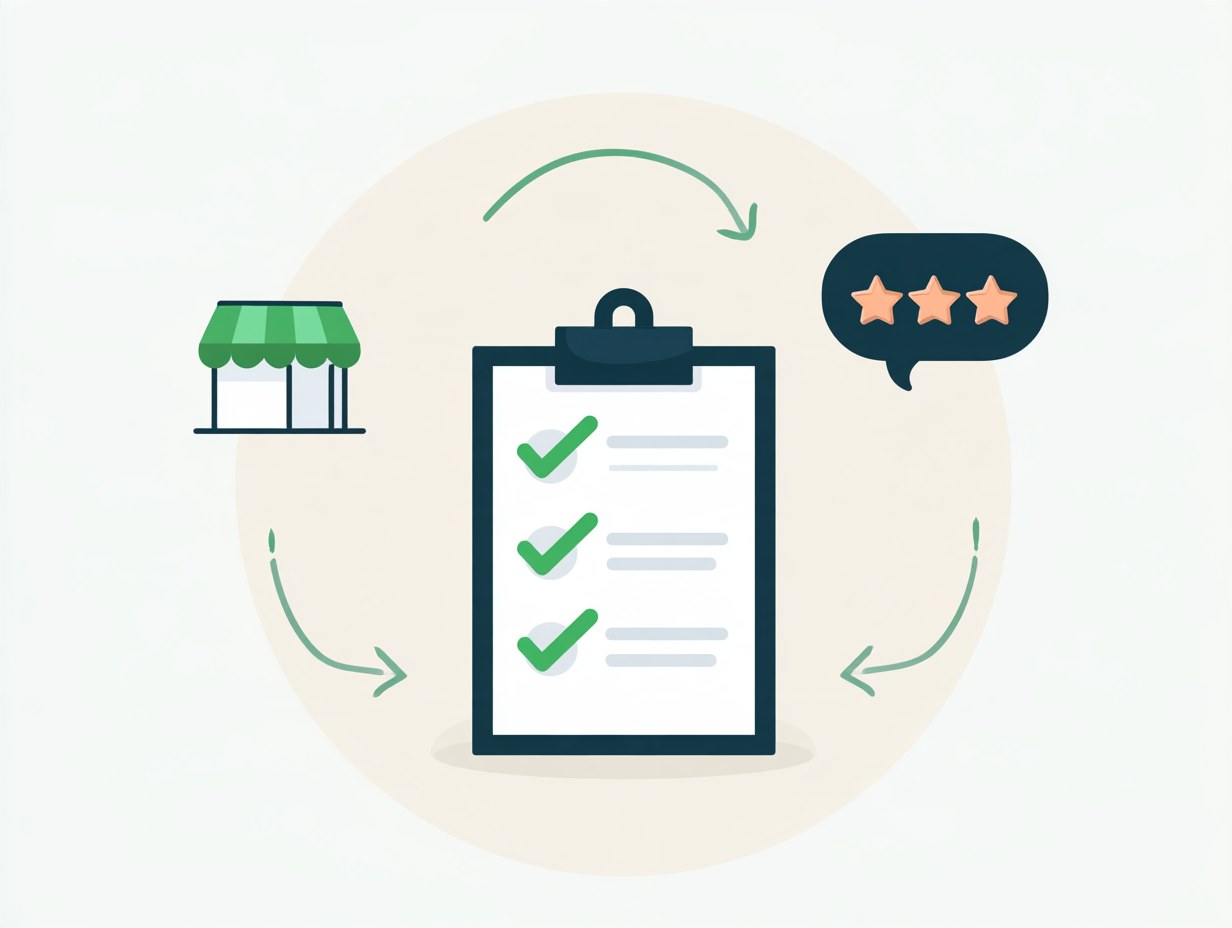
I call this the Weekly Review Rhythm. Ask every week. Answer every week. Check the score every month. Call it standard work, the same way a good plant runs.
How My Own AI Workforce Taught Me to Check the Source
I don't just talk about this. I live it every day.
I run my business with a team of AI agents. They draft my emails, pull together research, and get content ready while I'm getting my girls off to school.
The rule that makes it work is simple. AI drafts. A human decides. Nothing goes out, nothing gets booked, nothing gets bought until I say so.
And the second rule matters even more for this topic. Every fact has to trace back to a source. The AI that helps me research articles like this one works under a hard rule: if a number can't be traced to where it came from, it gets cut. No exceptions.
That's exactly what your customers are doing with AI shopping answers. The AI drafts the recommendation. The shopper checks the source. And the source is your reviews.
When I look at AI shopping through my usual test, the one I run on every system I build, the question is simple. Does it give back Time, Money, or Energy?
For the shopper, yes. AI saves them the time of reading 40 websites. Reviews save them the money of buying the wrong thing.
For you, the owner, it depends on your scorecard. With fresh, real, answered reviews, AI does free marketing for you while you're busy doing the work. Without them, you're invisible in the one place your customers start.
Here Is What That Could Look Like in a Small Shop
Here's a made-up example to help you picture it. The shop and the people in it are invented for illustration.
Say you run a two-person bike repair shop in a strip mall. You have 23 Google reviews, almost all 5 stars. The newest one is from last spring.
A parent asks Gemini, "Where can I get my kid's bike tuned up before the holidays near me?" Your shop might show up. But when the parent clicks in, the most recent review is eight months old. The shop down the road has 14 reviews from the last two months, and the owner replied to every one.
Who gets the call?
Now picture you start the Weekly Review Rhythm in late November. After each repair, you text the customer a thank you and your review link. You reply to each new review by Friday, in your own words. By January you have a dozen fresh reviews that say things like "fixed my daughter's brakes in a day" and "explained what was wrong without the upsell."
Same shop. Same work. Very different scorecard.
Seven Steps to Get Your Reviews Ready for AI Shoppers
Here's how I'd set this up. Most owners can do steps 1 through 4 in one evening.
- Check your scorecard tonight. Open your Google Business Profile and count how many reviews you got in the last 90 days. Write that number down. That's your starting point. If it's zero or one, this is your biggest job for the season.
- Ask every customer, every time. Build the ask into the end of every job or order. A short text or email within 24 hours, with a direct link to your review page. Ask everyone, not just the customers you think are happy. Google's review policies don't allow you to only ask the happy ones, and the FTC's rule against fake reviews took effect in October 2024. Never buy reviews, trade discounts for good ones, or write them yourself.
- Make it easy to be specific. In your ask, give one simple prompt. "If you have a minute, tell people what we helped you with." That one line turns "Great job!" into "Fixed our garage door the same day." Specific reviews help shoppers. They also give AI summaries real details to repeat.
- Reply to every review in your own words. Thank the good ones by name and mention the job. Answer the bad ones calmly, own what you can, and offer to make it right offline. BrightLocal found generic, templated replies put off 50% of consumers. You can let AI help you draft, but read it, fix it, and make it sound like you before it posts.
- Read your 1- and 2-star reviews like a shopper would. 55% of shoppers start there. Ask yourself one question: if I were a stranger, would this reply make me trust this business more or less? If less, rewrite your reply. A calm, honest answer to a bad review can win more trust than another five-star review.
- Use real photos, not AI people. Ask customers if you can share a photo of the finished job. Post real shots of your team and your work. Skip the AI-generated models in your holiday ads. 30% of North American shoppers in the Bazaarvoice survey say those turn them off the brand.
- Ask AI about yourself once a month. Open ChatGPT or Gemini and type the question your customers would ask, like "best bakery for custom birthday cakes near [your town]." See if you show up and what it says. Then check the AI review summary on your Google profile. If what it says is wrong or out of date, that's your signal to get more fresh, specific reviews.
Start with step one tonight. It takes five minutes, and it tells you exactly how much work the other six steps need.
Frequently Asked Questions
Do online reviews still matter if customers use AI to shop?
Yes. In Bazaarvoice's 2026 holiday surveys, just 1% of shoppers buy an AI-recommended gift right away, and 54% go straight to the customer reviews. AI tools also draw on reviews to make recommendations. Fresh, real reviews help you show up in AI answers and help shoppers trust what they see.
Does ChatGPT or Google AI use my Google reviews?
Google now shows AI-written review summaries above individual reviews on many listings, and BrightLocal found 82% of consumers read them. AI tools also pull from what customers say online when they answer "who's good near me" questions. Exactly which sources each tool uses changes, so keep your reviews current everywhere customers leave them.
How many new reviews does a small business need?
There's no magic number, but recent reviews count most. BrightLocal found 74% of consumers only care about reviews written in the last three months. A steady flow of a few new reviews every week or two beats a big burst once a year. Check your last 90 days and aim to grow it each month.
Should I use AI to reply to my reviews?
You can let AI help you write a first draft, but never post it without reading and editing it. BrightLocal found generic or templated replies put off 50% of consumers. Mention the customer's name and the actual job, fix anything that sounds robotic, and make sure every reply sounds like you on a good day.
What is the Weekly Review Rhythm?
The Weekly Review Rhythm is a simple habit for keeping your reviews fresh. Every week, ask every customer for a review with a direct link and a one-line prompt. Every week, reply to each new review in your own words. Every month, check your 90-day count and ask an AI tool what it says about you.
A Better Way to Earn Trust
Go back to that mom at 9:45 at night.
She asked AI for help, and it helped. It saved her an hour of searching. But she didn't hand over her trust to a chatbot. She went looking for real people who had already bought the thing. She read the bad reviews first. Then she decided.
Your customers are doing the exact same thing with your business right now. They ask AI who to call. Then they check what your customers have said.
You can't control what an AI tool says about you. You can control what your customers have to say, and whether they get asked to say it. You can control whether you reply. You can control whether your newest review is from last week or from two years ago.
That's the good news in all of this. The newest technology in the world still runs on the oldest thing in small business: people telling other people you did a good job.
Ask for it every week. Answer it every week. Let the AI carry it from there.
And keep asking the question that matters. Does this give me back Time, Money, or Energy?
Fresh reviews save your customers time. They bring you money you'd otherwise lose to the shop down the road. And they take a lot less energy than chasing every lead yourself.
That's A Better Way.
Keep Learning
- What Should Your Small Business Do When Google's Gemini AI Calls to Book? How to get your phone and booking process ready for AI callers.
- Should You Let ChatGPT Buy Things for You and Your Small Business? Where I draw the line on letting AI agents spend money.
- Is Relying on a Single AI Tool a Risk for Your Business? What to think about before you run everything through one platform.
- Your AI Agent Broke Something. Here's How to Know Before Your Client Does Simple ways to catch a problem with your AI setup early.
About the Author
Warren Schuitema is an AI Systems Consultant with Matchless Marketing and Matchless AI. Before AI, he spent 16 years in manufacturing and supply chain, where suppliers earned trust on a scorecard. Today he runs his own business with a team of AI agents built on two rules: AI drafts and a human decides, and every fact traces back to a source. He builds practical AI systems for small business owners and parent entrepreneurs, from a Weekly Meal Planner that replaced HelloFresh to a Digital Wall Calendar that replaced a $50 a month subscription. His test for every system is simple. Does it give back Time, Money, or Energy? Learn more at matchless-marketing.com.